Correlation between Enneagram and Jungian Typology
While studying the Enneagram and Jungian typology, I came to the conclusion that these two typology systems describe the same personality types using different parameters for description.
I want to note that I am writing about Jung's typology, which has 8 types, and not about the MBTI. MBTI is just a small slice of Jungian typology and in some ways contradicts it (especially in regard to the rationality-irrationality of types). Jung's typology, in contrast to the MBTI, talks about the nature of neurosis of each type and about the levels of psychological maturity of the types.
Unfortunately, not many people can compare the 9 Enneatypes with the 8 Jungian types, since Jung's 1921 book “Psychological Types” is written in very complex language and there are no modern descriptions of types written in plain understandable language.
Here is a list of Jungian types:
• Sensation Extraverted – Se
• Sensation Introverted – Si
• Feeling Extraverted - Fe
• Feeling Introverted – Fi
• Thinking Extraverted - Te
• Thinking Introverted - Ti
• Intuition Extraverted – Ne
• Intuition Introverted – Ni
When comparing Jungian typology and the Enneagram, the first thing that catches the eye is that these two typological systems have almost the same number of types: Jungian typology has 8 types, and the Enneagram has 9 types.
The Enneagram describes the psychological dynamics of types: healthy, average and unhealthy levels.
“It is almost impossible to make generalizations about the types without taking the Levels into consideration, because as each type deteriorates down the Levels, many of its characteristics become their opposite.” (1)
For each of the eight types Carl Jung also identified several levels of psychological harmony and indicated, what neurosis is inherent to this or that type, as well as described destructive behavior of a type in the lower levels.
When using the level-by-level description of Jungian types, the complete compatibility of Jungian types with the Enneagram types becomes obvious.
Here you can find a modern description of the four Jungian types (Se, Si, Ne, Ni) by level >>>
-------------------------------
Claudio Naranjo ("Character and Neurosis") and Don Richard Riso (“Personality Types Using The Enneagram for self-descovery”) compare Enneagram and Jungian typology. Their correlation is in the table below.
|
Enneatypes |
Don Riso |
Claudio Naranjo |
Helen Palmer* |
|
|
Jung |
Jung |
MBTI |
MBTI | |
|
1 |
Te |
Te |
ESTJ |
Judging |
|
2 |
Fe |
Fe |
Extravert, feeling |
|
|
3 |
ISTP |
Extravert, sensate, judging |
||
|
4 |
Ni |
INFJ, INFP |
Intuitive, feeling, perceiving |
|
|
5 |
Ti |
Si |
INTP |
Introvert, thinking |
|
6 |
Fi |
Ti |
ENTJ |
Introvert |
|
7 |
Se |
Ne |
INTJ |
Extravert, intuitive |
|
8 |
Ne |
Se |
Extravert, intuitive, thinking, perceiving |
|
|
9 |
Si |
Fi |
ISTJ, ESFJ |
Intuitive, perceiving |
*Comparison of Positive Correlations Among Enneagram Styles, Millon Personality Patterns, and Myers-Briggs Preferences (from Wagner and Walker, 1983)
Claudio Naranjo, in his book “Character and Neurosis”, has well described the levels of manipulation, aggressive imposition and self-destructive disappointment, and Don Riso, in his book “The Wisdom of the Enneagram”, has well described the levels of social and neurotic roles. As for Jungian typology, in his book "Psychological Types", Dr. Jung places the greatest emphasis on the disharmonious manifestations of types.
In his work "Character and Neurosis", Claudio Naranjo compares the Enneagram of personality types with other psychological character typing systems and discusses of the origins of each type.
After analyzing the characteristics of each of the Enneagram and Jungian types, as well as using the relation between Enneagram types and DSM*, established by Claudio Naranjo, I made the following correlation between these typologies:
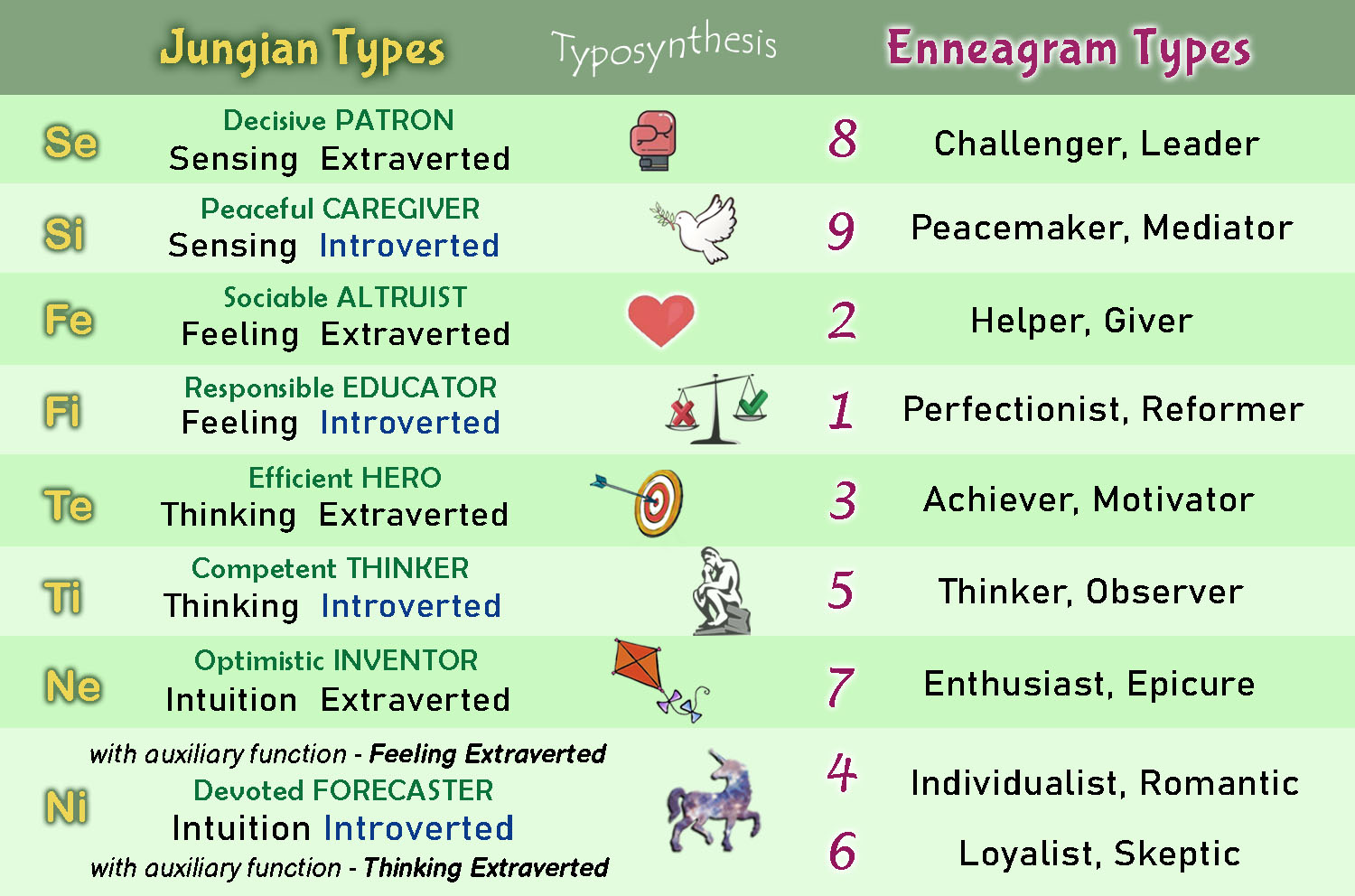
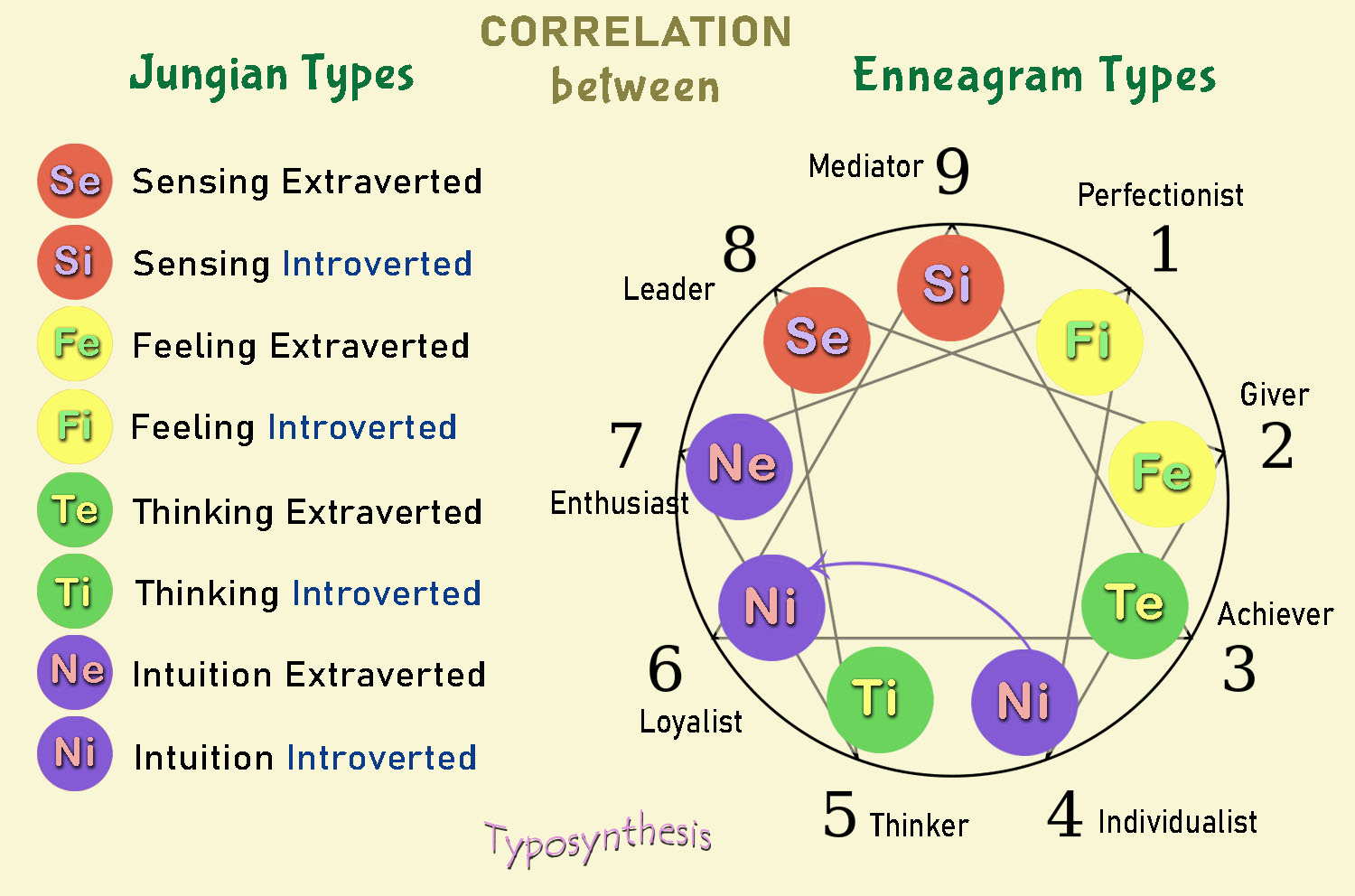
* DSM or Diagnostic and Statistical Manual of Mental Disorders (latest edition: DSM-5-TR, published in March 2022) is a publication by the American Psychiatric Association (APA).
Anzhelika Zabava
* * *
MBTI & Enneagram Correlations by Dr. A.J. Drenth here >>>
1 - Don Richard Riso, Russ Hudson. The Wisdom of the Enneagram, 1999. Chapter 6: Dynamics and variations. The levels of development
Last updating: 18.09.20025